
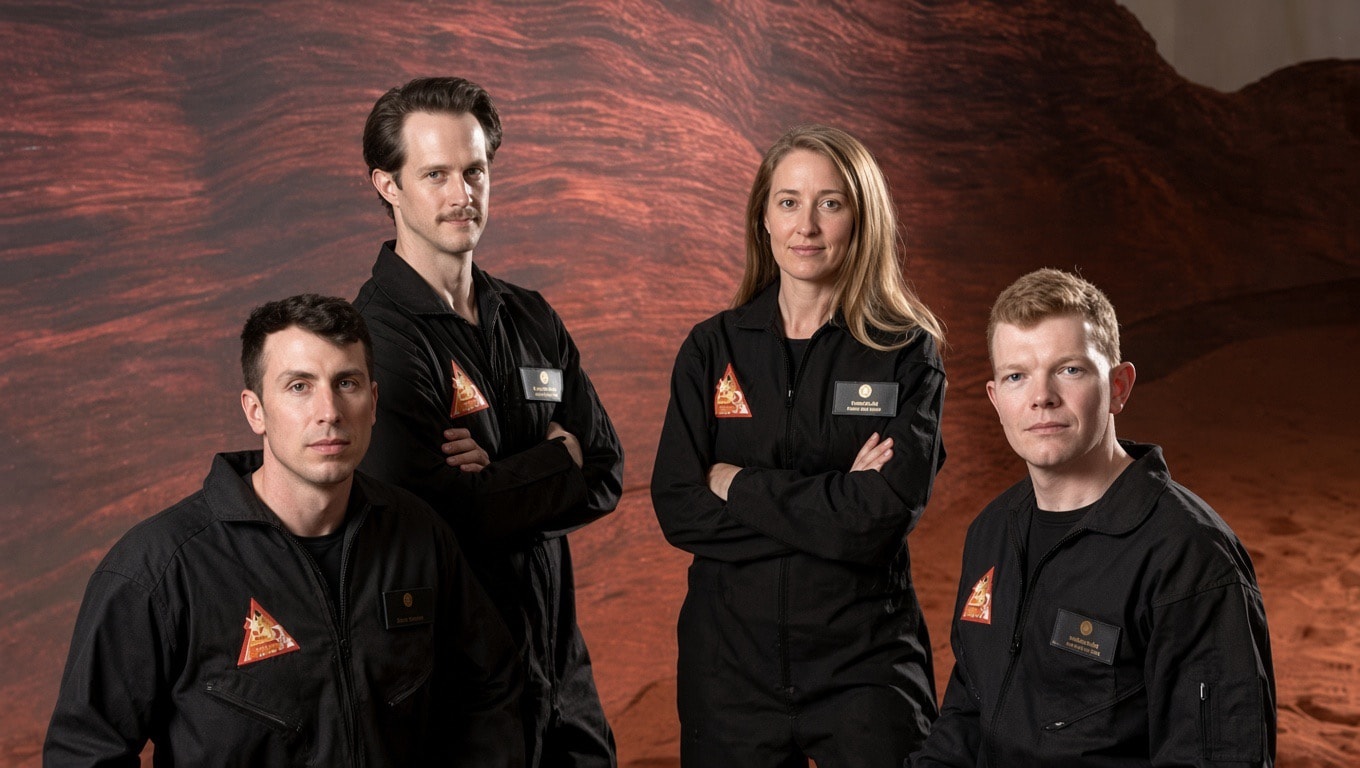
Four members of a NASA research team have completed a 378-day mission inside a simulated habitat designed to prepare for potential human exploration of Mars. The crew emerged from their living quarters at NASA’s Johnson Space Center in Houston on Saturday, bringing their year-long isolation experiment to an end.
According to Reuters, the team members described their experience of living for an extended period in a confined environment, isolated from the outside world, as valuable for planning future space missions.
Ellen Ellis, the mission’s medical officer, said after leaving the habitat that they had gone through a challenging year, voluntarily living in a confined environment while taking on the roles of astronauts participating in a hypothetical space mission.
The programme, known as the Crew Health and Performance Exploration Analog (CHAPEA), began on October 19, 2025. The four crew members were housed in a 158-square-metre, 3D-printed habitat designed to simulate living conditions on Mars.
During the mission, the crew carried out various activities, including growing plants in artificial soil resembling Martian soil, maintaining the habitat, and communicating with NASA officials. Communication delays were also introduced to replicate the time it takes for messages to travel between Earth and Mars, making the exchange of messages and responses similar to what would be expected during an actual deep-space mission.
Ross Elder, the mission commander, said sending humans to Mars would involve significant risks and challenges. However, he added that achieving this goal would be possible through scientific knowledge, effective leadership, innovation, perseverance and sustained effort.
NASA says the programme is designed to assess astronauts’ ability to adapt to everyday life, limited resources and the psychological and operational pressures of long-duration space travel. Under such conditions, crew members must maintain their physical and mental well-being, remain productive and preserve effective communication and cooperation with one another.
NASA is aiming to potentially carry out a crewed mission to Mars in the early 2030s. The latest mission was the second simulated expedition under the CHAPEA programme. During the first phase, four crew members also spent 378 days living in a similar environment between 2023 and 2024.
Following the end of their isolation, the second crew is expected to spend an additional two weeks evaluating the mission and sharing their experiences with NASA officials.
Vanessa Wyche, director of NASA’s Johnson Space Center, said the programme’s findings would play an important role in preparing for future missions to the Moon and, eventually, Mars.
Writer:Roya Stanikzai