
Writer:Salima Aryaei
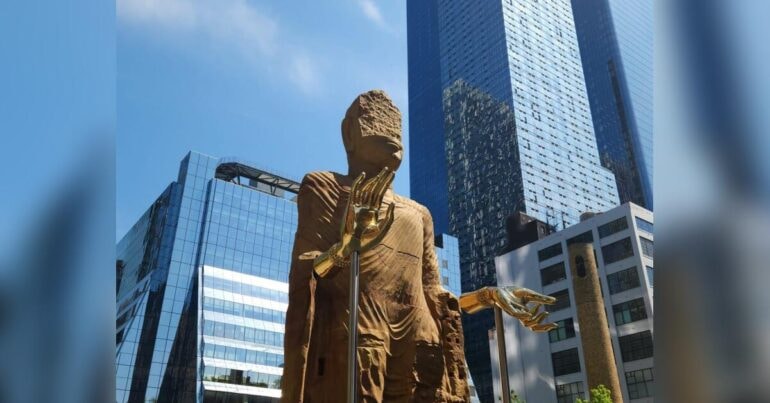
A sandstone statue inspired by the Buddha of Bamiyan’s Salsal statue is on display at High Line Park in Manhattan, New York. This artwork was created by Andrew Nguyen, a Vietnamese-American artist.
The artist named his sculpture “Salsal,” based on the meaning of the word, which translates to “the light that shines throughout the world.” According to Hyper Allergic media, the statue stands 27 feet tall and was recently installed at the intersection of West 30th Street and 10th Avenue in Manhattan.
This report states that the statue will be on display to the public until the spring of 2027. It is also noted that Nguyen has previously worked on reconstructing or reinterpreting war-related weaponry, particularly connected to the Vietnam War.
For the statue’s hands, which are separate from the main body, the artist used materials sourced from remnants of wartime munitions. He said he obtained these alloys through some of his friends in Bamiyan and then transported them to the U.S.
According to Nguyen, these materials were later transformed into “Mudras,” symbolic hand gestures in Buddhist and Hindu rituals. The right hand of the statue is in “Abhaya Mudra,” symbolizing fearlessness, and the left hand is in “Varada Mudra,” symbolizing generosity and sincerity.
He emphasized that this artwork is not a replica of the Salsal Buddha but a reflection of it. He stated that recreating such historical works is a way to preserve cultural stories, ideas, and memories.
The giant Buddha statues of Salsal and Shhamama were built in the 6th century in Bamiyan. The Taliban destroyed these historical landmarks in 2001 after seizing control of Afghanistan, an act that sparked widespread global condemnation.
After the fall of the Taliban regime, the previous Afghan government and UNESCO made several attempts to rebuild the statues, but ultimately, due to the lack of sufficient remnants, the decision was made not to reconstruct them.