
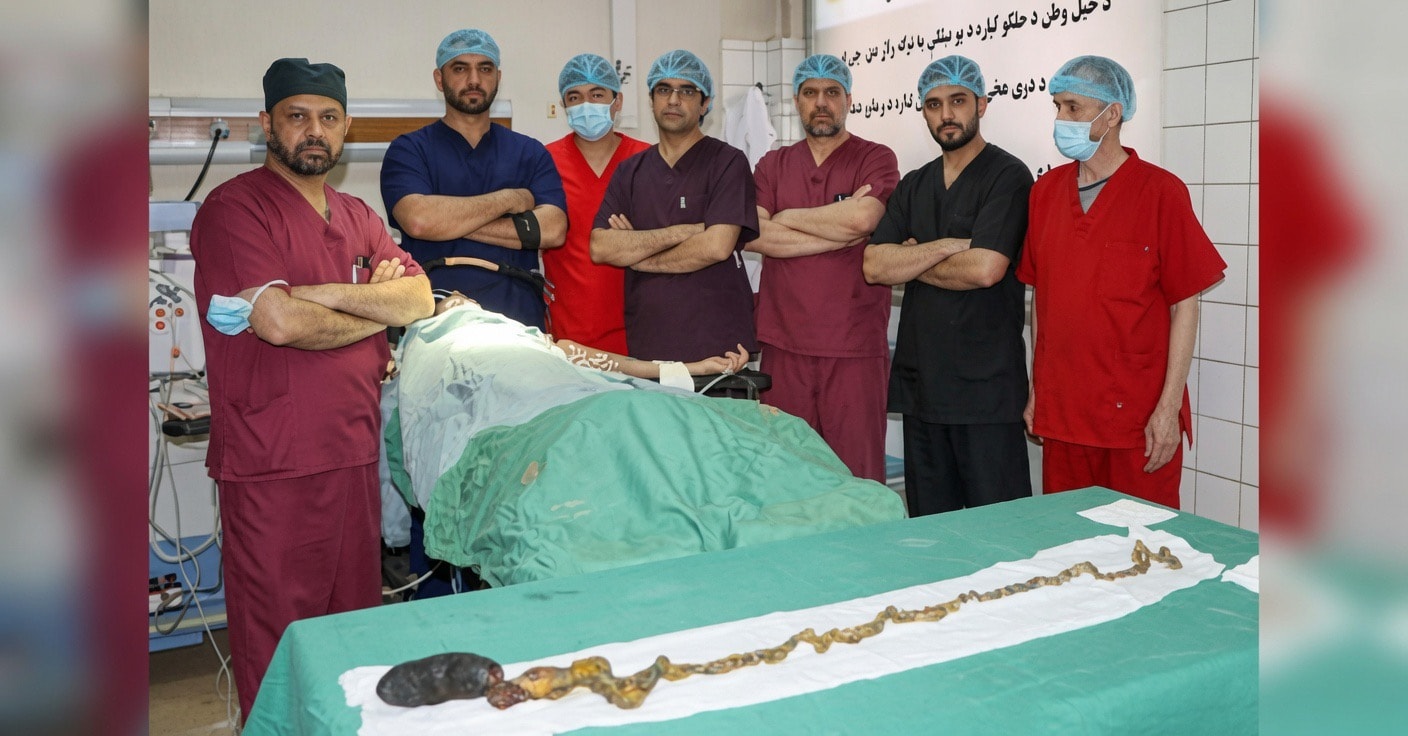
Doctors at the 400-Bed Sardar Mohammad Daoud Khan Hospital in Kabul successfully removed a massive hair mass from the stomach and intestines of a female patient during a surgical procedure.
In a statement released on Wednesday, June 17, the Health Command of the Taliban General Staff announced that the patient had traveled from Helmand Province to the military hospital to receive medical treatment.
According to the statement, the patient was suffering from a rare condition known as trichobezoar (a hair mass in the stomach), a disorder caused by the accumulation of ingested hair in the gastrointestinal tract. In severe cases, the condition can affect not only the stomach but also various sections of the intestines.
Doctors reported that the woman’s condition had reached an advanced stage. The large hair mass had completely occupied her stomach and extended into a significant portion of her intestines.
Nevertheless, the medical team successfully removed the entire mass from both the stomach and intestines through surgery. Physicians stated that the patient’s condition following the operation was stable and satisfactory.
Health officials also noted that, prior to seeking treatment at the 400-Bed Sardar Mohammad Daoud Khan Hospital, the patient had visited several healthcare facilities across the country but had not received effective treatment.
According to the medical team, specialized examinations and endoscopic evaluations conducted at the hospital led to an accurate diagnosis, after which the patient underwent surgery.
Trichobezoar, sometimes associated with Rapunzel Syndrome, is a rare condition that is often linked to underlying psychiatric disorders. It can develop as a result of trichotillomania (compulsive hair-pulling) and trichophagia (the ingestion of hair).
Because hair cannot be digested, swallowed strands remain in the gastrointestinal tract and gradually accumulate into a dense, compact mass. Over time, this mass may enlarge and extend from the stomach into portions of the intestines.
Medical experts explain that the condition may cause symptoms such as abdominal pain, nausea, vomiting, loss of appetite, weight loss, and, in more severe cases, intestinal obstruction or gastrointestinal bleeding.
Writer:Salima Aryaei